Best Broker API for Algo Trading
Choosing the wrong broker API is not a configuration problem — it is an architecture problem. The authentication model, paper-trading environment, asset coverage, and SDK quality each affect how quickly you can validate a strategy and how safely you can deploy it. This page compares 11 broker and execution APIs on the axes that matter for systematic traders. No investment advice, no affiliate links — neutral comparisons for researchers choosing their stack.
Choosing your stack — Module 2 hub cluster:
- Backtesting Frameworks
- Broker APIs ← you are here
- Market Data Providers
- Trading Platforms
- Event-Driven vs Vectorized Backtesting (concept)
- Programming Languages for Trading (concept)
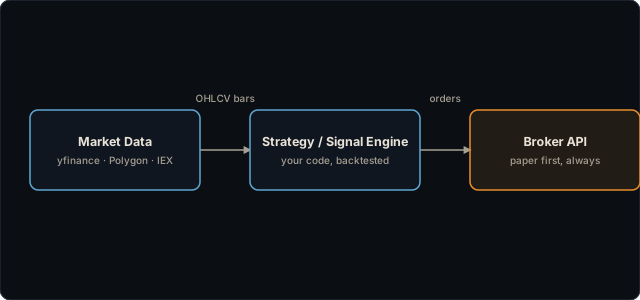
Broker API Comparison Table
All paper trading availability and official SDK facts confirmed as of June 2026. Cost structures marked [approx] where exact figures were not publicly accessible; re-verify before committing.
| Broker / Venue | Assets | Paper? | API Type | Official SDKs | Min Capital / Cost |
|---|---|---|---|---|---|
| Interactive Brokers | Stocks, options, futures, FX, bonds (global) | Yes (separate paper user) | TWS API (socket), Client Portal REST+WS, FIX | Python, Java, C++, C#; community ib_async (maintained) | $0 (Lite); data fees vary |
| Alpaca | US stocks, ETFs, options, crypto | Yes (free, global signup, real-time) | REST + WebSocket | alpaca-py, JS/TS, Go, C#, MCP server | $0, commission-free; free IEX data tier |
| Tradier | US stocks, ETFs, options (no futures on this API — see note below) | Yes (sandbox 15-min delayed; prod quotes real-time even unfunded) | REST + streaming; native OTOCO/OCO brackets | REST-first; community Python/JS | $0 min; Lite $0.35/trade+contract, Pro $10/mo commission-free |
| TradeStation | US stocks, ETFs, options, futures | Yes (SIM mirrors live) | REST + streaming | REST spec; community wrappers | API free; ~$10k funded account may apply [approx] |
| Tastytrade | Equities (+fractional), options, futures, crypto | Yes (cert sandbox, resets 24h) | REST + WebSocket | Official; community Python tastytrade | Free account |
| Tradovate | Futures (CME complex) | Yes (demo) | REST + WebSocket | REST-first; community wrappers | API add-on ~$25–30/mo + CME data fees [approx] |
| OANDA | FX (~68+ pairs), metals, CFDs | Yes (fxPractice demo) | REST v20 + streaming | v20 REST; community oandapyV20 | $0 (US); spread-based cost |
| ccxt (library) | Crypto, 100+ exchanges | Per-exchange sandbox flag | Unified REST + WS (ccxt.pro) | JS/TS, Python, PHP, C#, Go | Free (MIT) |
| Binance | Crypto spot, margin, futures | Yes (Spot Testnet) | REST + WebSocket + FIX | Official connectors; community python-binance | Free API; ~0.1% spot fees |
| Coinbase Advanced Trade | Crypto spot | No realistic paper | REST + WebSocket | coinbase-advanced-py | Free API; tiered fees |
| Robinhood | Crypto only via official API; NO official stocks/options API | No | REST (crypto only) | None official for equities; robin_stocks (unofficial) | $0 account |
Six Points of Nuance the Table Cannot Capture
1. ib_insync is archived — use ib_async for new projects
ib_insync was the dominant Python wrapper for Interactive Brokers' API for years. Its author, Ewald de Wit, passed away in early 2024, and the repository was archived read-only on March 14, 2024. The maintained community successor is ib_async (ib-api-reloaded organization, lead: Matt Stancliff), with v2.0.1 released June 2025, requiring Python 3.10+. Existing ib_insync code continues to work but receives no bug fixes; new IBKR Python projects must use ib_async. Tutorials and blog posts referencing ib_insync are now out of date.
2. Robinhood has no official equities API
Robinhood launched an official REST API for crypto trading only. There is no official Robinhood API for stocks or options. The community library robin_stocks uses web-scraping techniques to access the internal API, but it is explicitly not supported by Robinhood, has no stability guarantees, and can break on any platform update. For commission-free US equity API access with official support, Alpaca is the standard replacement — it is free, has no minimum deposit, and has multiple official SDKs.
3. IBKR headless Linux authentication is genuinely complex
Interactive Brokers' Client Portal Gateway (the headless REST/WebSocket API path) requires a daily web-based 2FA session. In a Linux server context, sessions time out in approximately six minutes without a /tickle keepalive, the gateway resets daily, and the IBKR Key 2FA approval window is approximately two minutes. The community tool IBeam (Docker container) was purpose-built to automate this; it is the standard solution for unattended IBKR automation. This complexity is not present in Alpaca, Tradier, or ccxt-wrapped crypto APIs.
4. Tradovate API access is a paid add-on
Tradovate direct API access requires a paid add-on subscription (~$25–30/mo, approximate, plus CME exchange data fees). Some authorized third-party vendors (TradersPost, PickMyTrade) can act as CME sub-vendors, which changes the fee structure. Re-verify current pricing at Tradovate directly before building a project on it. This is different from the Tradovate trading account itself, which has no subscription fee.
5. Paper trading sandbox ranking
For most systematic traders, the best-to-worst paper sandbox ranking is: 1) Alpaca (free, real-time, email-only, stocks+options+crypto, closest to live behavior) — 2) TradeStation SIM (most production-grade especially for futures, but expects a funded account) — 3) IBKR paper (most realistic multi-asset, same auth complexity as live) — 4) Binance Spot Testnet (best free crypto sandbox, pairs with ccxt) — 5) OANDA fxPractice (best FX sandbox) — 6) Tastytrade cert sandbox (good for options/futures API testing, but 24-hour reset breaks persistent portfolio tests) — 7) Tradier sandbox (delayed data). Not recommended: Robinhood (no paper), Coinbase Advanced (no realistic paper).
6. Alpaca vs Tradier for options
Both Alpaca and Tradier support US options via REST APIs and offer free paper or sandbox environments. Tradier's sandbox uses delayed data, which makes it less representative for time-sensitive strategies — though its production host serves real-time quotes even on an unfunded account, and it offers native server-side OTOCO/OCO bracket orders that Alpaca does not. Alpaca's paper environment uses real-time IEX data. For most options algo work starting out, Alpaca's paper environment produces more realistic results; Tradier has a history of stable API access and is a reasonable production choice, especially where server-side bracket handling matters. See the full Tradier profile for the API surface, pricing, and regulatory detail.
7. Tradier added futures in 2026 — but not on this API
Tradier Inc. now operates Tradier Futures, a separate legal entity (a DBA of Lazzara Consulting Inc., NFA/CFTC member, distinct from Tradier Brokerage Inc.'s FINRA/SIPC registration) with a $500 account minimum. It runs on a CQG-powered manual trading platform. The documented Trading API used for algorithmic order placement still accepts equity, option, multileg, and combo order classes only — no futures order class is published as of this session. For the site's futures-specific vendor coverage (Tradovate, NinjaTrader Brokerage, Rithmic, CQG), see Futures Trading Vendors.
How to Choose / Best For Whom
- Free paper trading, any asset class, fastest start: Alpaca. No friction to get started; real-time data; supports stocks, ETFs, options, and crypto.
- Multi-asset (stocks, options, futures, FX, bonds): Interactive Brokers. Broadest coverage; use ib_async (not ib_insync) for Python.
- Futures specifically: Tradovate (be aware of the API add-on cost) or TradeStation (funded account requirement).
- FX and CFDs: OANDA. Free account, fxPractice demo, official v20 REST API.
- Crypto across many exchanges (unified abstraction): ccxt. MIT, 100+ exchanges, JS/Python/Go.
- Options and futures API testing: Tastytrade cert sandbox. Good for testing the API itself, but be aware of the 24-hour reset.
- Learning and cost-sensitivity: Alpaca paper → IBKR Lite live. Both have no minimum deposit and commission-free pricing on equities.
What this page does not cover: This hub compares broker and execution APIs. For the backtesting frameworks that produce the signals you connect to a broker, see Backtesting Frameworks. For the data feeds you use in your backtest, see Market Data Providers. For charting platforms with native algo execution (NinjaTrader, MetaTrader), see Trading Platforms. For a single-page profile of Tradier's API, see Tradier; for paper/options/futures/streaming/bracket support side by side across venues, see the Broker Capability Matrix; for futures-specific infrastructure (Tradovate, NinjaTrader Brokerage, Rithmic, CQG), see Futures Trading Vendors. AlgoDrill does not cover broker performance, fill quality, or live execution strategy — those involve real capital and require your own due diligence.
Frequently Asked Questions
- What is the best broker API for algorithmic trading beginners?
- Alpaca is the default beginner pick. It offers a free paper trading environment with no minimum deposit, email-only signup, real-time data (IEX tier), REST and WebSocket APIs, and official Python, TypeScript, Go, and C# SDKs. It supports US stocks, ETFs, options, and crypto in paper mode. Paper fills behave similarly to live fills, making it the most representative free sandbox. The second-best beginner option for paper-only work is IBKR paper, which is more realistic but has more complex authentication.
- Is ib_insync still maintained?
- No. The ib_insync library was archived read-only on March 14, 2024, following the author's passing. The maintained successor is ib_async, developed by the ib-api-reloaded organization (lead: Matt Stancliff). ib_async v2.0.1 was released in June 2025 and requires Python 3.10 or newer. New projects should use ib_async; existing ib_insync code will continue to work but will not receive bug fixes or compatibility updates.
- Does Robinhood have an official stock trading API?
- No. Robinhood has an official API only for crypto trading. There is no official Robinhood API for equities or options. The community library robin_stocks provides unofficial access via web scraping, but it is not supported by Robinhood and may break without notice on any platform update. For commission-free US stock API access with official support, Alpaca is the standard alternative.
- What is the best free paper trading sandbox?
- Alpaca is the consensus best free paper trading sandbox for most strategies: free, no minimum deposit, email-only signup, real-time US equity and crypto data, and stocks/ETFs/options/crypto support. For futures, TradeStation SIM is the most production-grade but typically requires a funded account. For FX, OANDA fxPractice is the strongest free option. For crypto specifically, the Binance Spot Testnet pairs well with the ccxt library. Tastytrade's certification sandbox is useful for options and futures API testing, but resets every 24 hours, making persistent portfolio testing impractical.
- Does Interactive Brokers API work on Linux without a GUI?
- Yes, via IBeam — an open-source Docker-based container that manages the Client Portal Gateway (IBKR's headless REST and WebSocket API). IBeam handles authentication automatically, but IBKR's security model imposes constraints: sessions time out in approximately six minutes without a /tickle keepalive, the gateway resets daily, and the initial 2FA approval window is approximately two minutes for IBKR Key. For headless automation, IBeam is the standard solution. TWS API (socket-based) requires TWS or IB Gateway running, which also needs display management on headless Linux.
Drill broker API trade-offs, paper sandbox selection, and IBKR authentication patterns with AlgoDrill's spaced-repetition flashcards.
Start Flashcards → View Reading List →