Build Your Own AI Trading Agent
A short, hands-on paid course from AlgoDrill: architect, build, guardrail, and score your own LLM-driven trading agent — the same five-layer pattern that runs the real agent documented in our production case study. Eight modules, runnable notebooks, delivered as Markdown plus a PDF through Gumroad. No login, no on-site gate — you own the files the moment you buy.
LLM-ready by design. The download ships the modules as clean Markdown alongside the PDF — built so you can drop them straight into Claude Code (or any LLM) and have it teach you, quiz you, or pair-build the agent with you as you read, not just a static file you scroll through once.
What You Build
Every module fills in one or more layers of the same five-layer pattern: an LLM signal-generation layer proposes; a guardrail layer it cannot override gates; a deterministic execution state machine acts; a performance-feedback layer scores every read and closes the loop back into signal generation. This is not a diagram you re-derive later — Module 2 stands up the real scaffold, and every later module extends it with runnable code.
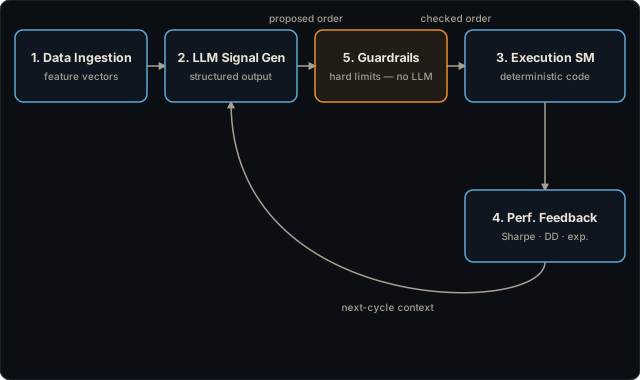
The Full Syllabus
Eight modules, written chapter by chapter, six with a companion Jupyter notebook:
| Module | What It Covers | Notebook |
|---|---|---|
| 1. Capabilities & Limits | What LLM agents are reliably good at vs. not, read straight from the current benchmark literature covered in depth on our research landscape and benchmark review pages, plus the concrete failure modes: hallucinated confidence, stale context, mid-session drift. | — |
| 2. Agent Architecture | The five-layer reference pattern above, stood up as real stub classes wired to live data. | Scaffold |
| 3. The Decision Packet | Turning raw bars into LLM-readable context: VWAP, opening range, momentum, pre-market levels, a rendered chart for multimodal prompts, and freshness gates. | Packet + chart |
| 4. The Decision Loop | A multimodal prompt that returns a structured, clamped decision (direction, confidence, a high-probability gate) and heartbeat logging so a stalled loop is never mistaken for "no trade." | Paper decision loop |
| 5. Risk & Guardrails | Sizing off a fixed per-trade risk cap, OTOCO/OCO brackets, trailing ratchets, climax-chase and stop-geometry vetoes, event blackouts. | Sizing + brackets |
| 6. Scoring the Agent | Counterfactual decision grading against the market's next 15/30/60-minute move — why a high-frequency reads log tells you whether you have an edge in weeks, not months. | Decision scorer |
| 7. Paper → Live | Broker API wiring (Alpaca paper / Tradier), reconciliation, preflight checks, a kill switch, and a go-live checklist. | Paper broker adapter |
| 8. Case Study: Weeks of a Real Agent Trading Real Money | The real, sanitized trade log of the reference agent — winners and losers, each loss traced to the specific guardrail it produced. Finishing a final accuracy pass before it ships to the download; every other module is available now. | — |
Proof, Not Promises
Every course sells confidence. Here is what you can actually check before you buy:
- A real agent, live since mid-2026. Not a backtest fantasy — an actual LLM-driven loop running against a real brokerage account, documented in our production case study.
- Losses included, on purpose. Module 8 walks losing trades with the same detail as winners — no cherry-picking, no survivorship-biased highlight reel.
- Evidence you can read for free, right now. The case study is not a teaser behind a paywall — it is the same architecture, guardrails, and honesty standard this course teaches, published in full before you spend a cent.
- Audit-driven, not vibes-driven. Every guardrail in Module 5 exists because a specific, logged failure produced it, not because it sounded prudent in the abstract — the case study's "Guardrails With a Birth Certificate" section shows exactly how that works.
Exact trade-by-trade figures from Module 8 are finishing a final accuracy pass before publication. This section will be extended with them once that is done — until then, the case study above is the complete, independently-checkable record of how the system behaves.
What's in the Download
- Eight modules as clean Markdown — built to be LLM-ready: drop them into Claude Code or your own LLM and have it teach you, quiz you, or help you build the agent alongside the reading, not just render as a static file.
- The same content as a built PDF — for reading start to finish without a tool in the loop.
- A zip of runnable Jupyter notebooks — one per module that has one, pinned dependency versions, real executed output.
- Gumroad handles delivery and receipts. No account on AlgoDrill, no login, no on-site gate — you buy on Gumroad, you get the files, that is the whole flow.
Get the Course
Build Your Own AI Trading Agent
$9.99 launch price with code LAUNCH · $19.99 list
The full 8-module course: text + notebooks + PDF, LLM-ready Markdown, delivered via Gumroad.
Best for: builders who want the complete architecture, the guardrail discipline, and the paper-to-live checklist end to end.
AI Trading Agent Starter Kit
$4.99
A smaller, plug-and-play paper-trading agent kit you stand up in under an hour with Claude Code and a free broker sandbox account — no separate LLM API key required.
Best for: a fast, cheap taste of the pattern before committing to the full course.
Use code LAUNCH at checkout to drop the course from $19.99 to $9.99. Gumroad is the merchant of record for both products — receipts, delivery, and refunds all run through Gumroad, not AlgoDrill.
Frequently Asked Questions
- What do I actually get when I buy?
- A zip delivered by Gumroad: eight course modules as clean Markdown (LLM-ready -- drop them into Claude Code or your own LLM), the same content built as a PDF, and a folder of runnable Jupyter notebooks with pinned dependencies. No login and no on-site gate -- everything unlocks immediately on Gumroad.
- Is this investment advice, or a guarantee I'll make money?
- No. This is engineering education, not investment advice. Results are not typical, and the reference agent documented in the course has lost money on individual trades and will again -- Module 8 shows that directly instead of hiding it. Nothing in this course, or on AlgoDrill, is a recommendation to buy or sell any security.
- Do I need to already know Python?
- You should be comfortable reading and modifying Python -- the notebooks are real code, not pseudocode. If you are new to the stack, AlgoDrill's free /code walkthroughs and flashcard drills cover the prerequisites: backtesting, position sizing, and reading a strategy's stats.
- How is this different from the free Module 11 pages on AlgoDrill?
- The free pages are the map: what LLM trading agents can do, the architectures researchers have published, and whether the benchmarks say they work. This course is the build: the actual five-layer implementation, module by module, with the guardrail and scoring code the free pages only describe.
- What is the Starter Kit, and how is it different from the full course?
- The Starter Kit is a smaller, $4.99 product: a plug-and-play paper-trading loop you stand up in under an hour, using Claude Code itself as the decision engine so you don't need a separate LLM API key. The full course teaches the complete architecture, the reasoning behind every guardrail, and the paper-to-live discipline -- the kit is a fast taste of the pattern, not a substitute for it.
- Who handles payment, delivery, and refunds?
- Gumroad. It is the merchant of record for both products -- checkout, receipts, file delivery, and any refund request all go through Gumroad, not AlgoDrill directly.
Not ready to buy yet? Read the free case study first, or start the architecture guide AlgoDrill already gives away.
Read the Case Study → Free Architecture Guide →