Look-Ahead Bias in Backtesting
Look-ahead bias is the most insidious backtesting error: the code looks correct, the equity curve looks beautiful, and the strategy fails immediately in live trading. It occurs when the backtest uses price information or signal values that would not have been available at the moment the simulated decision was made. The fix requires both correct data and correct execution timing.
Module 5 — Backtesting Rigorously: Backtesting Pitfalls (pillar) · Walk-Forward Analysis · Deflated Sharpe Ratio · CPCV · Survivorship Bias · Look-Ahead Bias ← you are here
See also: Event-Driven vs Vectorized Backtesting (structural prevention of signal shift errors)
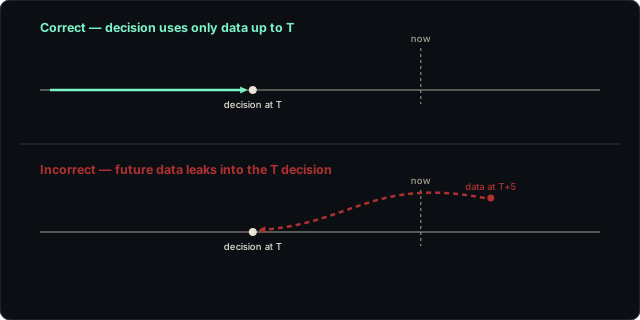
What Is Look-Ahead Bias?
A backtest is a simulation of trading decisions through historical data. For the simulation to be valid, each decision must use only information that was available at the moment of that decision in real time. Look-ahead bias occurs when this constraint is violated: the backtest decision at time T uses information that became available only after T.
This violation is almost always unintentional. The researcher downloads historical prices from a provider, computes indicators, generates signals, and tests entry/exit logic — without realizing that some step in that pipeline introduced future information. The resulting backtest produces performance figures that cannot be replicated in live trading because live trading enforces the information boundary that the backtest silently crossed.
Look-ahead bias is distinct from survivorship bias (which corrupts the universe of instruments) and overfitting (which corrupts the parameter fitting). It is an information-timing error that can affect a strategy with a single parameter and a bias-free universe if the data or execution timing is wrong.
The Three Dominant Failure Modes
1. Retroactive price adjustment
Most EOD data providers supply back-adjusted prices: they retroactively revise historical prices to account for stock splits, dividends, and corporate actions that occur after the original date. When you download daily price data today for a stock going back to 2010, the 2010 prices reflect adjustments for every corporate action through today — actions that did not exist in 2010.
A momentum signal computed on today's back-adjusted 2010 price is based on a price that no real trader ever saw. The signal incorporates knowledge of future corporate actions. If a 3-for-1 stock split occurred in 2018, the adjusted 2010 prices are one-third of the original prices — a fact that was invisible to traders in 2010.
The fix is point-in-time data: prices adjusted only for events that had already occurred as of the bar's date. Norgate Data provides explicitly point-in-time adjustment factors. For providers that supply only fully back-adjusted prices, the alternative is to store raw prices and maintain a separate adjustment-factor time series, applying only the factors for events that predate each bar.
2. Signal shift errors
In vectorized backtesting code, signals are typically computed as a time series: signal = (close - MA200) / close. If the researcher then assigns a position based on signal[t] to return[t] — using the same bar's closing price for both the signal and the return — they have committed a signal shift error. You cannot know the closing price until after the bar closes; you cannot trade at that close if your signal depends on that close.
The earliest a signal based on bar T's close can be acted on is bar T+1's open. In vectorized code, this requires a one-bar shift: position = signal.shift(1) and pairing with open[t+1] rather than close[t]. Off-by-one errors in array alignment are among the hardest to detect visually — the code looks plausible and the backtest produces a plausible-looking equity curve.
Event-driven engines are structurally immune to signal shift errors. The engine calls the strategy's handler after bar T closes. At that moment, bar T+1's prices are physically absent from the engine's state. The strategy can only schedule orders for T+1's open. There is no mechanism to accidentally use bar T+1's price in a bar T decision. See Event-Driven vs Vectorized Backtesting for the full architectural comparison.
3. Rolling-window warmup contamination
Rolling indicators require a warmup period: a 200-day simple moving average is undefined for the first 199 bars. Many vectorized implementations handle this by backfilling with a partial mean or zero, or by including entries before bar 200 without flagging them. Any entry before bar 200 uses an invalid SMA value — a form of look-ahead bias because a 200-bar SMA implicitly spans a period longer than the available history.
The fix is straightforward: filter entries to bars strictly after the lookback period completes. In Pandas: df = df.iloc[lookback:]. In event-driven frameworks: track the indicator's validity state and block entries until it reports valid (i.e., the warmup period has elapsed).
In Vectorized vs Event-Driven Engines
| Failure mode | Vectorized engine | Event-driven engine |
|---|---|---|
| Retroactive price adjustment | Vulnerable (data problem, not engine problem) | Vulnerable (data problem, not engine problem) |
| Signal shift error | Vulnerable — researcher responsible for shift | Structurally prevented — engine enforces bar boundary |
| Warmup contamination | Vulnerable (researcher responsible) | Vulnerable (researcher responsible; indicator validity tracking recommended) |
The Complete Fix
Eliminating look-ahead bias requires addressing all three failure modes:
- Point-in-time data source. Use Norgate Data (explicitly bias-free) or reconstruct point-in-time adjustment factors from raw price series. Avoid downloading data as back-adjusted prices without verifying that the adjustments are point-in-time rather than full-history retroactive.
- One-bar execution shift. In vectorized code: shift signal arrays by one bar and pair with the next bar's open. In event-driven code: this is enforced automatically.
- Warmup enforcement. Track the lookback period for every indicator and filter entries to bars strictly after warmup completion. Add a check that fails the backtest if entries exist within the warmup window.
These three fixes together close the dominant look-ahead channels. Additional sources — using future volatility estimates in position sizing, including lagged macro data at non-point-in-time release dates — require domain-specific review, but the three above account for the vast majority of look-ahead bias found in systematic trading research.
Frequently Asked Questions
- What is look-ahead bias in backtesting?
- Look-ahead bias occurs when a backtest uses information that was not available at the time of the simulated trading decision. The engine or the researcher implicitly treats future data as known at an earlier point in time. The result is artificially inflated performance that vanishes in live trading, because live conditions enforce the information boundary that the backtest violated. Look-ahead bias is distinct from survivorship bias (which involves the universe) and overfitting (which involves parameter count) — it is specifically an information-timing error. Even a single-parameter strategy can exhibit severe look-ahead bias if the data is not point-in-time.
- How does retroactive price adjustment cause look-ahead bias?
- Most data providers supply back-adjusted prices: historical prices are revised retroactively to account for splits, dividends, and corporate actions that occur after the original date. A price file downloaded today for 2015 data may embed adjustments for actions that occurred in 2018, 2020, and 2024. A momentum signal computed on today's adjusted 2015 prices incorporates the knowledge that those corporate actions happened — information that did not exist in 2015. The correct approach is point-in-time data: prices adjusted only for events that had already occurred as of the date of the bar. Forward-adjusted series built bar by bar from raw prices, and raw unadjusted series with explicit adjustment factors, are both valid alternatives.
- What is a signal shift error?
- A signal shift error is a specific form of look-ahead bias where a trading signal computed on bar N's closing price is used to enter a position at bar N's closing price. This is impossible in practice: a closing price is not known until after the bar closes, at which point the market session is over. The earliest a signal based on bar N's close can be acted on is bar N+1's open. In vectorized backtesting code, off-by-one shifts in arrays are a common source of this error and are difficult to detect visually. Event-driven engines are structurally immune to signal shift errors because the strategy's handler is called after the bar closes, before the next bar opens — the next bar's prices are physically absent from the engine's state.
- Does using an event-driven framework eliminate look-ahead bias?
- Event-driven frameworks structurally prevent signal shift errors, the most common form of look-ahead bias. They do not prevent retroactive price adjustment bias or rolling-window warmup contamination. If the historical data fed into an event-driven engine contains retroactively adjusted prices, the bias is in the data, not the engine — the engine faithfully processes whatever data it receives. Similarly, if an indicator's warmup period is ignored and entries occur before the indicator has enough bars to be valid, the bias is in the strategy logic. An event-driven engine and point-in-time data together eliminate the most common look-ahead biases. A vectorized engine with strict information discipline can achieve the same result, but the discipline is the researcher's responsibility rather than the framework's.
- What is point-in-time data and why does it matter?
- Point-in-time data means that the value stored for any date reflects only information that was publicly available on that date, using only adjustments for events that had already occurred. It is the opposite of retroactively adjusted data. For corporate actions: a dividend paid on 2020-01-15 would be reflected in the adjustment factor only from 2020-01-15 onward in a point-in-time dataset; retroactively adjusted data would apply that same adjustment back to 2010 and earlier. Point-in-time data eliminates retroactive-adjustment look-ahead bias at the data source level. Norgate Data provides explicitly point-in-time adjustment factors. For providers that supply only fully back-adjusted prices, the alternative is to store raw prices and maintain a separate adjustment-factor time series applied only to dates after each event.
Drill look-ahead bias mechanisms, data quality checks, and backtesting rigor with AlgoDrill's spaced-repetition flashcards.
Start Flashcards → View Reading List →